Tuesday, March 7, 2023

Langley City Council Approves its 2023 Budget

Last night, Langley City Council adopted its 2023 budget and 2023-27 Financial Plan Bylaw. Like all bylaws, the budget and Financial Plan go through three readings and final adoption.

Third reading of a bylaw is where Council thoroughly debates and proposes amendments to bylaws. If Council approves third reading of a bylaw, it is known as “approval in principle.” In the case of a rezoning bylaw, it is between third reading and final adoption when a proponent of a rezoning would finalize all the requirements and financing for their development project.

In BC, there must be one day between third reading of a bylaw and final adoption. To me, the final adoption of a bylaw serves two purposes. It ensures developer accountability in the case of rezoning and serves as a “cool down” period for other bylaws.

If Council wants to amend a bylaw after third reading, but before its final adoption, they must rescind third reading of a bylaw, debate and makes proposed amendments, and revote on third reading. Revoking third reading of a bylaw is a serious matter.

Over the weekend, the provincial government announced how it will allocate its one-time $1 billion grant to local governments. Langley City will be receiving $7.2 million.

Council debated rescinding third reading of the budget last night. Council discussed applying the $7.2 million grant to help offset the $15 million investment to support SkyTrain. This change would result in lowering this year’s proposed property tax by 1.8% (about $46.70 for detached home and $19.38 for attached home property owners.)

Like most municipalities in BC, Langley City has a growing infrastructure renewal debt. In response, Langley City Council has been slowly increasing its “infrastructure levy” property tax component over the years. 1% of this year’s property tax will increase the “infrastructure levy” to help close the gap as Langley City must complete $242 million in infrastructure renewal over the next decade.

Given our need to renew infrastructure and our current funding gap, Council decided against rescinding third reading of the budget bylaw and adopted the budget bylaw.

Once the province provides the $7.2 million to Langley City and specifies how we can use the grant, Council will likely amend the budget to invest this grant into infrastructure renewal.

Monday, March 6, 2023

One-Third of People Travelling on 200th Street Use Public Transit in Peak Periods

When you drive along Fraser Highway or 200th Street, you might think that only a few people are using public transit along those corridors, but that isn’t the case.

TransLink recently released the first part of its 2023 Bus Speed and Reliability Report. One of the maps that stood out to me was a map of bus mode share in 2021.

Bus mode share in 2021 during AM peak travel period. Select the map to enlarge.

On 200th Street between Langley City and Walnut Grove, 33-45% of people travel along that corridor on public transit during peak AM travel periods. Between Langley City and King George SkyTrain Station, 21-35% of people travel along Fraser Highway on public transit, with the highest percentage in Langley City.

Along 72nd Avenue in Surrey, up to 72% of people travel along that corridor on public transit during peak periods.

TransLink staff presented this report at the March 2nd Mayors’ Council on Regional Transporation Meeting. At that meeting, I asked if the percentage of people using transit was similar in the peak PM travel period. TransLink staff said that a similar percentage of people used public transit along the identified corridors on the map.

Some people might think this doesn’t make sense, given what they see on the roads daily, but buses are way more efficient at moving people around. For example, a 40-foot transit bus with just six passengers uses less road space per passenger than private automobiles. A 40-foot transit bus can hold about 70 people. If you look at buses in Langley, they are usually full during peak AM and PM travel periods.

For more information, please read the “2023 Bus Speed and Reliability Report.”

Thursday, March 2, 2023

Langley City Council calls for fair taxation and a new deal for municipalities to invest in infrastructure

In BC, municipalities are part of two organizations that help represent our combined interests to the province government. They are part of local area associations and the Union of BC Municipalities.

While these organizations do many other things, one of the ways that they help advocate on behalf of local governments to the provincial government is through the resolutions process.

I will explain how this process works and share two resolutions Langley City Council submitted at our last meeting.

Water Infrastructure in Langley City

Local governments, like Langley City, will pass resolutions at Council meetings that they would like to see forwarded to their local area association. In Langley City's case, this is the Lower Mainland Local Government Association.

Representatives from local governments debate these resolutions at their area association's annual convention. For resolutions that pass, they get forwarded to the Union of BC Municipalities. At the Union of BC Municipalities annual conference, local government representatives from throughout the province debate these resolutions. For the ones that pass, the Union of BC Municipalities forwards them to the province as these resolutions represent what local governments want the province to take action on.

The first resolution that Langley City Council forwarded to our local area association was around residential property taxes. Because there is only one residential tax rate per BC law, and because detached and attached housing change values at different rates, it leads to inconsistent property tax changes. The following tables show the change in tax rates over the last several years by housing type in Langley City.
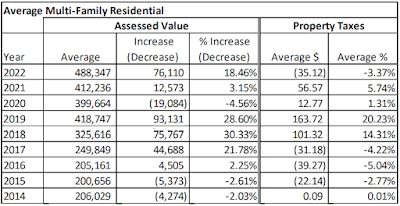
Change in average attached housing valuation and property taxation between 2014 and 2022 in Langley City. Select the table to enlarge.

Change in average detached housing valuation and property taxation between 2014 and 2022 in Langley City. Select the table to enlarge.

As a note, attached housing includes apartments, townhouses, and rowhouses.

The motion is:

WHEREAS the Province of British Columbia specifies that there is one assessment class for all types of residential properties even though the assessed value of attached and detached residential properties change values at different rates and other jurisdictions, such as Ontario, allow different tax rates for attached and detached residential properties;
WHEREAS in Langley City, a 4.94% property tax increase in 2018 resulted in a 0.4% decrease for detached residential properties and a 14.31% increase for attached residential property, and in 2022, a 4.35% property tax increase resulted in a 12.49% increase for detached residential properties and 3.37% decrease for attached residential properties;
THEREFORE BE IT RESOLVED that the Province of British Columbia amend the BC Assessment Act and the Community Charter to allow the residential class to be split into two distinct residential classes so that a different rate may be applied to each type to account for the difference in the rate at which attached and detached residential properties change their value and to allow local government to more accurately charge for the cost of providing services to attached and detached residential properties.

Langley City Council approved the second resolution around infrastructure funding. Like all municipalities in BC, we are responsible for most public infrastructure on the ground, such as transportation, sewer, and water.

In Langley City's 10 square kilometres, the City owns $600 million (replacement value) in transportation, sewer, and water infrastructure. In the next decade, we need to invest $242 million to keep this infrastructure in a state of good repair. Like all municipalities in BC, we need more financial resources to do this. Today, we all have growing infrastructure debts. We have this problem because local governments collect less than 5% of all taxation, with the rest going to the feds and the province. We need a new deal from the feds and the province.

The motion is:

WHEREAS Canada’s infrastructure deficit is estimated to be as high as $570B with almost 60% of the deficit within municipal jurisdictions.
WHEREAS the costs to replace and repair municipal infrastructure for critical services such as roads, arenas, bridges, drinking water, and wastewater systems are estimated to be $141 billion, which is well beyond the financial capacity of municipalities across the country due to limited revenue generation options, and all while costs for infrastructure renewal continue to escalate at an exponential rate.
THEREFORE, BE IT RESOLVED that the Government of Canada create a sustainable and reliable municipal asset management fund, like the permanent Building Canada’s Public Transit Future Fund, to increase investments in infrastructure renewal, which is essential to enhance public safety, reduce health risks, ensure economic sustainability, and lessen the financial burden on future generations to pay for the infrastructure deficit.

I look forward to debating these motions at this year's conferences.

Wednesday, March 1, 2023

Council Notes: Rezoning and 2023 Budget

On Monday, Langley City Council gave third reading to its 2023 budget, also known as the Financial Plan 2023-2027.

I’ve made the following post about this year’s budget which you can read for more information:

Langley City’s 2023 Budget Overview

A Deeper Dive into Langley City’s Proposed 2023 Budget: On-going Operating Budget

A Deeper Dive into Langley City’s Proposed 2023 Budget: One-time Capital Projects

Council will vote on the final reading to adopt the budget at its March 6th meeting.

Langley City Council also gave final reading to a rezoning and issued a development permit to enable the construction of a 15-unit townhouse project at 19665 & 19669 55A Avenue. You can read more about this project in a previous post.

A rendering of the view of the project from its internal drive. Select the image to enlarge.

A rendering of the view of the project from 55A Avenue. Select the image to enlarge.