Monday, May 30, 2022

I’m running for mayor because we need to work together for a better Langley City!

I'm excited to announce that I'll be running for Mayor of Langley City in the upcoming fall municipal election.

As a senior manager of operations for a large retailer and over my two terms as a city councillor, I know that we get the most done when we work together. And we have a lot we need to get done in Langley City, a community that I'm proud to call home.

Like every great community, we have our share of challenges. We must improve community safety, take meaningful action on reducing homelessness, build more affordable housing, mitigate the impacts of climate change-induced flooding, and enhance our greenspace.

With SkyTrain coming to our community, we are at a critical crossroads in Langley City. To move forward in a positive direction, we must work together with our federal and provincial government partners and local community leaders.

As a leader, I work best when collaborating with others. I will continue to work with residents, the business community, other elected representatives, and community organizations to get things done.

I look forward to sharing more about my vision for Langley City in the coming months and how I plan to work together with others to move this vision forward.

Let's make Langley City the place to be!

PS: A mayoral campaign costs $24,434.63 in Langley City. If you are interested in donating, you can write a cheque or use a credit card. Under BC law, you can donate up to $1,250.

Mailing Address:
Nathan Pachal Election Fund
16 - 19631 55A Ave
Langley, BC V3A 0L5

Donate by Card:

Thursday, May 26, 2022

South of Fraser and Industrial Area Routes Leading Transit Recovery

When I first got involved in the “Smart Growth” movement in Metro Vancouver more than a decade ago, people in the movement (who were primarily Vancouver-based) thoughts that the South for Fraser would be hard to serve by transit. They thought people in Delta, Surrey, White Rock, and Langley were not “transit people.” These Vancouverites also believed it was a fool’s errand to provide transit service through industrial areas. Who would take transit service to industrial areas?

Person on a bus

Some of these misconceptions even made their way to TransLink planning. TransLink believed that industrial areas wouldn’t support high-quality transit services for the longest time. The good news is that TransLink listened to the community and started improving transit service in a big way about a decade ago in the South of Fraser, including industrial areas.

TransLink recently released its 2021 Transit Service Performance Review. 2021 was a year of transit ridership recovery, and it was interesting to see two things.

The first is that transit ridership recovery was the strongest in the South of Fraser.

Ridership recovery by sub-region in Metro Vancouver at the end of 2021. Select map to enlarge.

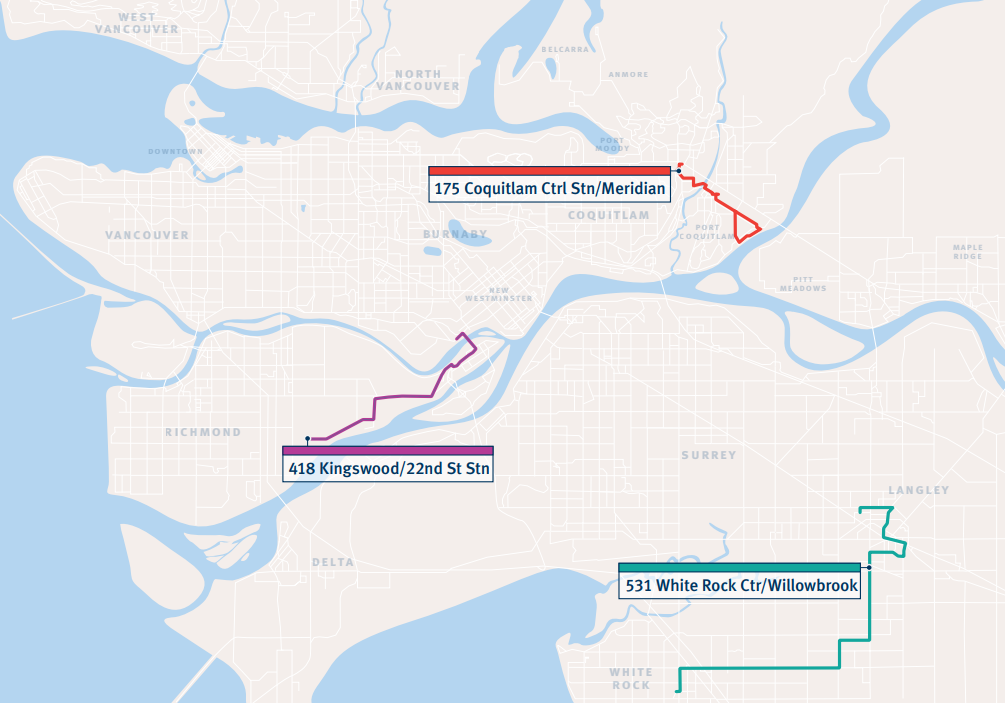
The second is that ridership on some transit routes through industrial areas grew even beyond 2019 levels.

The 175, 418, and 531 transit routes serving industrial areas saw around 100% or greater ridership recovery in 2021. Select map to enlarge.

These insights show that there is still pent-up demand for quality transit service in the South of Fraser. It also shows that it makes sense to provide quality transit to industrial areas in Metro Vancouver. There is still one industrial area, Gloucester Industrial Estates, in the Township of Langley that doesn’t have transit service at all. I wonder if it is time to trial transit service to this area?

Wednesday, May 25, 2022

Impact of Noise on Health is Real – What Can Municipalities Do?

55 A Ave

For about 15 years, I lived in an apartment that backed onto the floodplain. While I wasn’t shielded from all sounds from 53rd Avenue, these sounds were muted. I was never worried about the sounds of traffic waking me up at night if I left a window open.

Last summer, I moved to an apartment that fronted 203rd Street at Industrial Avenue. Some traffic would drown out my TV if I left the windows open. I never kept windows open at night.

I now own a townhouse at the end of 55A Avenue that fronts the street. It is right next to 196th Street. This street is quiet though a few people enjoy their subwoofers or crank the bass in their vehicle, including at night. These loud sounds impact all people along the street. I’ve been woken up a few times.

There are also some folks with vehicles that have loud mufflers that race across the 196th Street overpass.

I know I might sound like an alarmist, but urban noise harms cardiovascular health, creates cognitive impairments, causes sleep disturbance, impacts mental health, and has pulmonary effects.

So, what can a municipality do about urban noise?

One of the things that municipalities can do is require developers to improve the sound reduction from the exterior to the interior of buildings. It makes a big difference. For example, the apartment on 203rd Street has excellent sound reduction from the exterior. I cannot say the same about my townhouse. The good news is that Langley City’s newly adopted Official Community Plan states that:

Development fronting the SkyTrain guideway, and/or any Provincial Highway, major arterial and railway, shall incorporate measures to mitigate noise impacts and incorporate Canada Mortgage and Housing Corporation’s (CMHC) guidelines for maximum acceptable levels of noise in dwellings, including triple-glazed windows, additional wall insulation, sound dampening or absorbing walls and cladding materials, and concrete construction, solid glazed balconies, sound absorptive landscaping and street tree plantings, and water features.

Recent housing projects along major roads in Langley City now incorporate these recommendations.

The best solution is to reduce the noise at the source by enforcing mufflers and speaker/subwoofer sound levels. Of course, like enforcing speeding, this is easier said than done. In Paris, they are trialing an automated method to enforce loudness levels.

Today, we understand that noise pollution negatively impacts human health, and we are now starting to look at ways to mitigate these impacts in urban areas.

Tuesday, May 24, 2022

Ghosts of the Past: Remains of the Electric Interurban Passenger Rail System

Up until the mid-20th century, Metro Vancouver and the Fraser Valley had an extensive electrified passenger and freight rail service network. The most famous line is the Interurban that ran from Downtown Vancouver to Chilliwack. Seventy years ago, I would have been able to take one train from Langley City to my work in Downtown Vancouver.

Unfortunately, BC Electric (whose assets are now owned or operated by BC Hydro, FortisBC, Southern Rail, and TransLink) didn’t renew or expand its passenger rail service, but let the service degrade over time. BC Electric converted the Interurban passenger service to diesel bus service, and the rest is history.

You can read more about the history of the Interburan on this blog or view some of the historic passenger and freight rail maps of Metro Vancouver and the Fraser Valley.

The Interurban is still an active freight line today, and you can still see some of the older passenger rail “stations” and power substations along the line.

This long weekend, I checked out two of the easily accessible and remaining substations. The first is located at 256th Street and 68th Avenue. There is even an interpretive plaque.

Coghlan Substation. Select image to enlarge.

Coghlan Passenger Waiting Hut. Selet image to enlarge.

If the building looks familiar. You’ve likely seen it on a TV show, including the now-cancelled “Chilling Adventures of Sabrina.”

The other substation is located at 39623 Old Yale Rd in Abbotsford. This substation was fully renovated into a mansion and is currently listed for sale. You can also find it on Airbnb.