Monday, September 30, 2019

Renewal at City Park, Brydon Park, and Trail Network

One of the keys to supporting a happy and healthy community is a great parks system. As our community continues to grow with new townhouses and apartments, the parks system is becoming even more critical for people’s well-being. Langley City has been reinvesting significantly into our parks and trails in recent years.

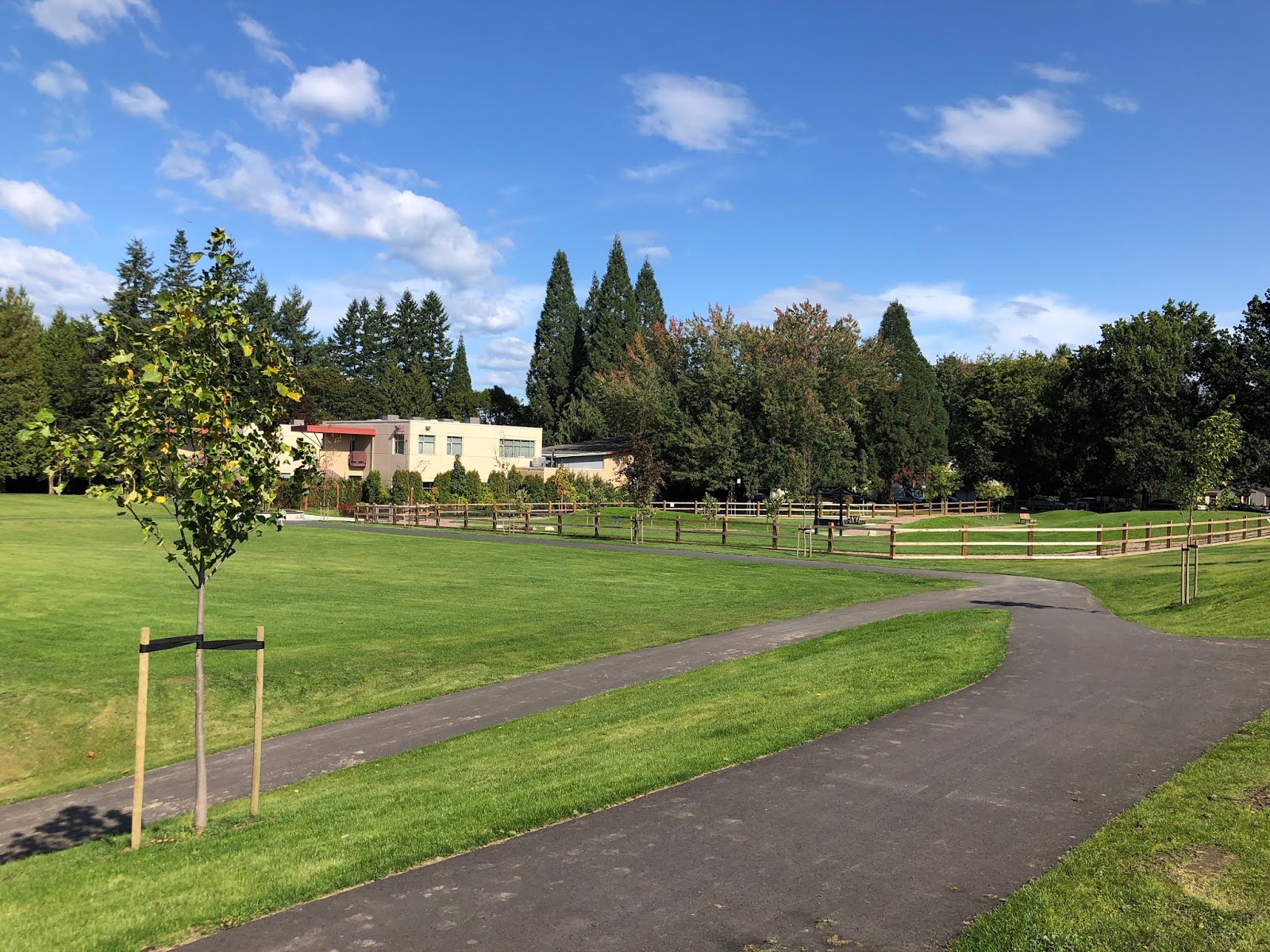
City Park is currently undergoing a multi-phase renewal. This weekend, I took some pictures of the latest improvements to this park. The first set of pictures shows the new dog off-leash area which will be having its grand opening on October 21st.

New dog off-leash area at City Park. Select image to enlarge.

Water fountain and entrance to dog off-leash area in City Park. Select image to enlarge.

The next set of pictures shows the new perimeter path and other walking paths that have been added to the now more formalized central part of City Park.

New perimeter path at City Park. Select image to enlarge.

New paths in central area of City Park. Select image to enlarge.

Formalized seating area at City Park. Select image to enlarge.

Langley City has an extensive trail network, but sometimes the trailheads can be hard to find. The parks department has been working on making these entrances more visible. The City is also rolling out garbage cans at all trailheads as this is something that has been requested by many people in the community.

Trailhead at 208th Street near Douglas Crescent. Select image to enlarge.

Trailhead at 208th Street to Nicomekl Trail System. Select image to enlarge.

Finally, Brydon Park is starting its multi-phase renewal. This will be another critical park for our community as it serves the new higher-density area along 198th Street. This first phase of construction for the renewal is expected to start this winter which includes a dog off-leash area and new nature walking trail.

Brydon Park - Phase 1 Renewal Concept Plan. Select image to enlarge.

Langley City is also working on the Nicomekl River District plan which will continue to support renewed investment into our community’s parks and trails.

Thursday, September 26, 2019

Paved paradise and put up single-family housing and parking lots. Impervious surfaces in Metro Vancouver.

Earlier this week, I posted about the importance of the urban tree canopy in Metro Vancouver’s urban areas. Trees provide ecological services which support human, environmental, and economic health.

The Metro Vancouver Regional District recently released a report about the urban tree canopy and impervious surfaces in our region. Langley City is near the bottom of the list with a lower amount of tree cover. To learn more, please read my previous post.

While a healthy tree canopy is good for our region, impervious surfaces degrade the health of our region. Impervious surfaces can include buildings, roads, driveways, paths, and parking lots.

Impervious surfaces have a negative impact on environmental and human health. When it rains, stormwater goes directly from parking lots and roads into streams. This water is unfiltered which means it is full of chemicals and garbage from impervious surfaces that end up directly into our ecosystem.

Stormwater should be allowed to filter through the ground which helps remove toxins before they end up into our ecosystem, and eventually eaten by us as these toxins work there way up the food chain.

The urban heat island effect is also exacerbated by impervious surfaces. This is why it always feels warmer in parking lots than in parks.

One of the things that I hear is that density is reducing greenspace and creating more impervious surfaces, the opposite is true. Lower density development whether it be strip malls, office parks, or single-family housing is what is creating the most impervious surfaces in our region.

The following chart shows that 30% of the impervious surfaces in Metro Vancouver are in areas with single-family housing. 25% of impervious surfaces are due to roads in our region.

Distribution of impervious surfaces among land use types within the Urban Containment Boundary. Select chart to enlarge.

While each single-family lot is 50 to 60% impervious surface, compared to around 70% for apartments, single-family housing takes up a much larger footprint. This mean that single-family zoning creates more impervious surfaces as an absolute number, and per person housed.

Surface parking lots are generally 90% impervious surface while road right-of-ways are 69% impervious.

The following table show the percentage of imperious surface by each municipality within the urban containment boundary.

Percentage of impervious surfaces within the Urban Containment Boundary by member jurisdiction (2014). Select table to enlarge.

As you can see, 62% of Langley City is imperious surface with most of it in the Langley Bypass, Willowbrook, and Industrial areas.

Map of impervious surfaces in Metro Vancouver by parcel. The darker the green, the less impervious. The darker the grey, the more impervious. Select map to enlarge.

In Langley City, we have a whole lot of surface parking lots. With modern technology and best practices, you can now build parking lots that allow stormwater to be filtered on-site. There are ways that parking lots can be greened, including by planting more trees and requiring significant planted areas.

We are currently in the process of updating our zoning bylaw in Langley City. I’m hopeful that we will have these best practices required in the new bylaw to reduce the amount of impervious surfaces in our community, and to better manage stormwater in areas with impervious surfaces.

Wednesday, September 25, 2019

Langley City council meets with provincial ministers to advocate for more supportive services to reduce homelessness, and to create a fairer property tax system

This week, the annual Union of BC Municipalities (UBCM) conference is taking place at Canada Place in Downtown Vancouver. This conference provides an opportunity for people involved in local government to learn about how other local governments are addressing complex challenges, debate and pass resolutions to forward to the provincial government for consideration, and meet with provincial government ministers and staff.

Every year, Langley City council discusses which ministers we would like to speak with. Once that is decided, we determine who on council will speak with each minister. We tend to split up into smaller cohorts as to not overwhelm provincial ministers.

I was assigned, along with Councillor Rosemary Wallace, Councillor Paul Albrecht, and Francis Cheung who is the Chief Administrative Officer of Langley City to speak with Carole James who is the Minister of Finance and Judy Darcy who is the Minister of Mental Health & Addiction.

As the ministers meet with many people who are elected to, and work in local governments, we got fifteen minutes per meeting.

With Minister Darcy, we commended the province through BC Housing for building 49 units of supportive housing in Langley for people to get off the street and into housing with supports. These supportive services help transition people to independent living over time. We also commended the province through Fraser Health for funding a Langley ICM team which helps people who are living on the streets and who have substance-use issues get stabilized and into housing. Supportive Housing and the ICM team are how we reduce homelessness in Langley.

While the supportive housing facility near the Home Depot on 200th Street isn’t open yet, it will be at capacity when it does. The ICM team is already at capacity. Late last year, council wrote to the Ministry of Health asking for additional resources for the ICM team.

We noted to Minister Darcy that while a new supportive housing facility and current ICM team is a good start, with over 200 people living on the streets in Langley, we will need more resources. Minister Darcy noted that she would “look into it.”

She also noted a new program which will provides a one-time grant of up to $50,000 to fund projects such as needle distribution and recovery programs.

After meeting with Minister Darcy, we met with Minister James about creating two property tax classes: one class for single-family housing and another class for multi-family housing.

Currently, there is only one residential property tax class. This means that even if there is no increase in property tax revenue collected by the City, people will see wild year-over-year swings in their property tax bill due to the different rate of appreciation between multi-family and single-family housing. Minister James took some notes about this. This is the second year we have spoken to Minister James about creating two residential property tax classes.

We also asked for an update on cannabis revenue sharing between the province and local governments. We were told that this is currently being studied.

The UBCM conference is a good opportunity to meet with people elected to provincial government, and I was happy to advocate on behalf of Langley City residents with other members of council.

Tuesday, September 24, 2019

Urban Tree Canopy in Langley City and Metro Vancouver by the Numbers. High Density ≠ Less Tree Cover.

One of the strategic goals of Langley City council is to develop an urban forest management strategy. Tree’s provide important ecological services in urban areas. They combat the urban heat island effect, providing shading and cooling in the hot summer months. They also help manage stormwater and improve the health of streams, reducing flooding and cleaning up water. Trees also store carbon and help clean the air which helps combat climate change and improves human health.

With this in mind, it is critical that we increase the number of trees in our urban areas.

The Metro Vancouver Regional District recently released a report on tree canopy cover and impervious surfaces in our region.

In 2017, the regional district completed a high-resolution land cover classification for all of Metro Vancouver. This is like a high-end Google Satellite view that can be used to find parcel by parcel information on things like what kinds of buildings, the type of agricultural being grown, and the amount of tree cover on each individual parcel of land in our region.

The report was focused on areas within the urban containment boundary as shown in the following map.

Metro Vancouver Urban Containment Boundary. Select map to enlarge.

Areas outside of the urban containment boundary include conservation lands, large parks, rural lands, and agricultural lands. Within the urban containment boundary, the tree canopy covers 32% of the area. When the whole region is measured, including areas outside of the boundary, that number jumps to 54%.

The following map shows the tree canopy cover within the urban containment boundary. The grey areas within the boundary mean near zero tree cover. The darker the green, the more tree cover.

Tree canopy cover within Urban Containment Boundary in Metro Vancouver. Select map to enlarge. 

The following table shows the percentage of tree cover within each municipality. As stated earlier, this is only for land within the urban containment boundary.

Percentage tree canopy cover by municipality within Urban Containment Boundary. Select map to enlarge.  

Langley City is near the bottom of the list, and its not because of the higher density residential redevelopment that is occurring. It is because of the very grey areas along the Langley Bypass and Willowbrook Mall area. These areas need more trees.

Because of how building are constructed today, and the requirement for green space on properties of all densities, there is little difference between low-density and high-density residential buildings that are being constructed.

Average tree canopy by residential density over the years. High density is purple. Low density in yellow. Select table to enlarge.   

What is a good amount of tree canopy cover in urban areas? The Metro Vancouver report notes that it can range from 20% to 60% depending on what the natural environment was in the past. Knowing that most of Metro Vancouver was forested, closer to 60% is likely where we should be aiming for in our region.

Langley City is in the process of updating our Official Community Plan, and I’m hopefully that there will be policies in this update plan to increase the urban tree canopy in our community.

I’ll be posting about impervious surfaces later this week.