Wednesday, May 31, 2017

A new framework to preventing homelessness in our communities

The Canadian Observatory on Homelessness which is a partnership organization of academics from universities across Canada, services providers, and governments recently released a new framework on preventing homelessness in our country.

The number of people who are experience homelessness is increasing. This is evident in Metro Vancouver and in Langley City. The status quo cannot continue.
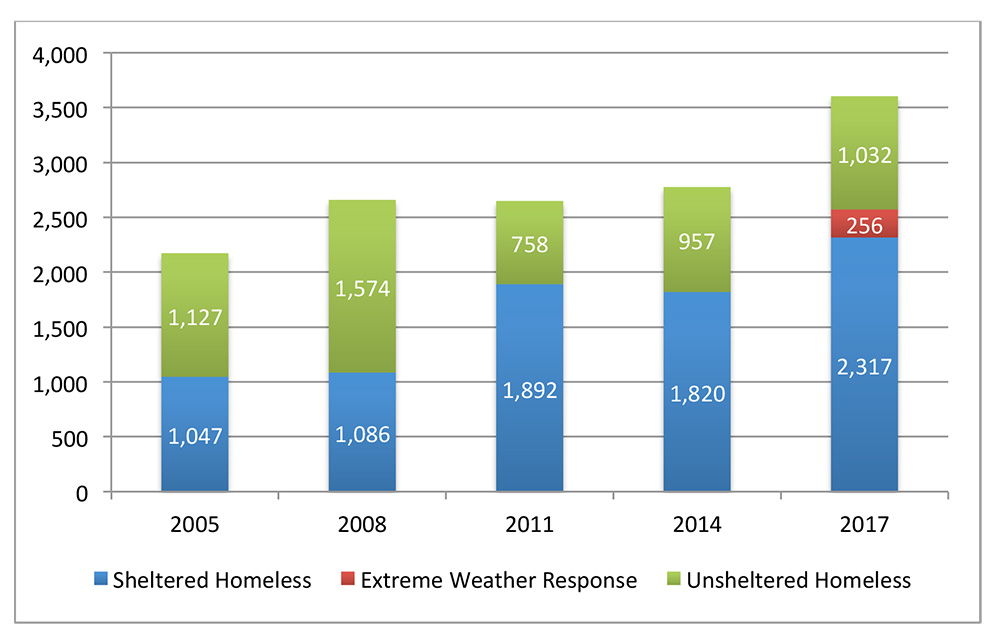
Proportion of the un-sheltered and sheltered people who are homeless in Metro Vancouver (2005, 2008, 2011, 2014 and 2017). Source: Metro Vancouver.

The new framework is titled “A New Direction: A Framework for Homelessness Prevention”. The framework consists of five broad categories. Not surprisingly, ensuring that people have access to long-term, affordable housing is critical to preventing homelessness as two of the five categories are around housing matters.

  1. Structural Prevention
    • “Structural prevention addresses factors that leave people at risk of homelessness, through legislation, policy, and investment. Its goal is to enhance social inclusion and housing stability.”
  2. System Prevention
    • “Systems prevention looks to respond to institutional and systems failures that contribute to the risk of homelessness. Systems prevention works… to ensure that people have access to the supports they need to prevent homelessness and its re-occurrence.”
  3. Early Intervention
    • “Early intervention consists of prevention policies and initiatives aimed at those at imminent risk of homelessness… [and] for those who have recently experienced homeless. A human rights approach also means we build supports and services for those at risk, rather than assume people will ‘bootstrap’ themselves out of homelessness.”
  4. Eviction Prevention
    • “Evictions prevention includes primary prevention measures such as strengthening landlord/tenant laws and social housing providers adopting a ‘no evictions’ mandate.”
  5. Housing Stability
    • “Housing stability are measures that support people to access and retain housing, in particular for those who have previously experienced homelessness… Housing First is a key model for promoting housing stability. The strategies offered through Housing First involve more than providing housing; housing must be complemented with a range of supports and services to meet individuals and families’ needs and desires.”

The following short video provides an overview of this framework.

A New Direction: A Framework for Homelessness Prevention from The Homeless Hub on Vimeo.

The number of people who are experiencing homelessness is increasing. Fresh approaches such as “A New Direction: A Framework for Homelessness Prevention” provides a framework for turning back the clock on the homelessness crisis in our communities.

Tuesday, May 30, 2017

May 29, 2017 Council Meeting Notes: Moving forward to reduce homelessness in our communities, and Local Government Awareness Day

At last night’s Langley City council meeting, there were only a few items on the agenda. Some councillors were on their way to the annual Federation of Canadian Municipalities Conference in Ottawa, and were not at the meeting.

At the end of April, grade 4 and 5 students from Langley City schools visited City Hall to learn about local government. The City has a “Getting to Know the City of Langley” guide which is distributed to students. Besides learning about local government, students also participated in a sponsored poster contest. Veronica Bryson from Nicomekl Elementary won the contest, and free lunch for her entire class as a result. Mayor Schaffer presented a certificate for winning the contest to Veronica at the council meeting. More information about Local Government Day and the contest can be found on the Langley City website.

Mayor Schaffer presenting a certificate to Veronica Bryson. Select image to enlarge.

Later during the meeting, council gave final reading to a zoning amendment bylaw for a small section of former lane near Park Avenue and 204 Street. Council also approved a request for Graham Flack who is the Deputy Director of Corporate Services to attend the Unit4 Connect Conference this year. Unit4 produces the software the City uses for financial and resource management.

Langley City adopted a Homelessness Strategic Plan last year. One of the key recommendations from that plan was to create a Homeless Action Table (HAT) with representation from local governments, the provincial government, federal government, social service agencies, and faith-based organizations in our community. The Homelessness Action Table’s first meeting was held on May 17th.

The mandate of the Action Table is to ensure that the recommendations made in the strategic plan are implemented. The current strategies that the Action Table are working on included:

Form a Homelessness Integration Team
Work with the Intensive Case Management (ICM) team to formulate a partnership between the ICM team and the HIT. This partnership will allow the parties to identify client-specific barriers to success and collectively identify solutions to respond. Participating members may consider using BC Housing’s Vulnerability Assessment Tool (VAT) or other client assessment tools. As an extension of this strategy, HIT could collaborate with the RCMP and Bylaw officers to respond to police/Bylaw calls related to persons experiencing homelessness.

Create a partnership agreement between the City and Township
HAT, through City Council, invite the Township to formally participate as a member of the HAT.

Support the feasibility study for a permanent supportive housing project
Advocate to BC Housing and Fraser Health for a permanent supportive housing project.

Increase the number of rent supplements in the Langley
Advocate to BC Housing to increase the rent supplements and the numbers of rent supplements.

Support the feasibility of developing a Youth Safe House
Support the new Youth Resource Centre and continue to advocate for a Youth Safe House.

Support integrated intervention approaches to health and housing
Work with the Intensive Case Management (ICM) team to formulate a partnership between the ICM team and the HIT to facilitate better integration between health and housing services. This includes employing teams to address issues related to hoarding, bed bugs and other health and housing related issues and supporting these efforts by making information and training available to social service providers, housing providers, outreach teams and other teams (e.g. Homelessness Integration Team).

Forming a partnership with the Township of Langley is key, and council passed the following motion last night:

WHEREAS the Homelessness Action Table (HAT) is an advisory coalition of various levels of government, social service agencies and faith based organizations dedicated to discussing homelessness issues in Langley and making recommendations on actions aligned with the Homelessness Strategic Plan; and

WHEREAS the Langley City Homelessness Action Table provides an opportunity to facilitate collaboration and partnership between community based agencies and the City and Township of Langley to implement Langley’s Homelessness Strategic Plan;

THAT a letter be sent to the Township of Langley inviting a member of their Council to sit on Langley City’s Homelessness Action Table.

Homelessness doesn’t respect municipal borders, and it will take all governments working together to reduce homelessness in our region.

Monday, May 29, 2017

Planning investment in water and sewer services, plus affordable housing in Metro Vancouver

Our regional district, Metro Vancouver, provides many significant services. The big three services that Metro Vancouver provides are for water, sewer, and solid waste (garbage, recycling, and organics).

When looking at your property tax bill, you’ll see a line item for Metro Vancouver, but that only represents a small amount of revenue that the regional district receives. Metro Vancouver charges municipalities for water and sewer services, and waste haulers for solid waste services, who then passed along the costs. In Langley City, between 60 to 70 percent of the charges on a typical tax bill for water and sewer services are passed to the regional district.

Providing safe drinking water and waste water treatment requires major investment in infrastructure. For example, the recently completed Capilano-Seymour water project cost $820 million. The North Shore Wastewater Treatment Plant which is starting construction is budgeted to cost $700 million. These are just two of the many projects that the regional district is or has worked on.

The Metro Vancouver board, which is mostly made up of elected officials from municipalities within the region, held a strategic workshop to help guide the development of a new 5-year financial plan.

The follow drawings were produced at the strategic workshop.

Metro Vancouver Board Strategic Planning Workshop - Scenario Directions. Select image to enlarge.

Metro Vancouver Board Strategic Planning Workshop - Details. Select image to enlarge.

Are you can see, there was a discussion about two scenarios for funding Metro Vancouver services. “Steady as We Go” and “Slowing Things Down”. The “Steady as We Go” option seemed to be the direction that Metro Vancouver board members felt the regional district needs to go. This scenario will require around a 5% annual growth in revenue. “Slowing Things Down” defers projects to the future which would increase risk of providing reliable services, increasing costs in the future.

Currently, developers pay for expanding local water and sewer services through Developer Cost Charges (DCCs) when new development projects are built. At the workshop, Metro Vancouver board members expressed interest in increasing DCCs to pay for regional projects that are required due to population growth.

Metro Vancouver is also an affordable housing provider. With the current affordable housing crisis in our region, workshop participants were interested in seeing the regional district’s role in providing affordable housing expand.

For more information about the workshop, read the “Board Strategic Planning Workshop – Discussion Summary” (starting on page 70.)

Thursday, May 25, 2017

Where do people live in Langley City? The vanishing single-family home

Langley City is 10 square kilometres, and the community’s residential areas were essentially built-out before the turn of the 21st century. All new housing in Langley City has come from redevelopment over the past several decades.

Our community has always had a mix of housing types, I found the following picture at City Hall earlier this week. As you can see, apartments were part of the mix even when Langley City still had farms.

Photo of Langley City from the mid-twentieth century, looking east along Fraser Highway. Select image to enlarge.

With the most recent census data now being released, I thought I’d look at what type of housing people are living in, both in terms of absolute numbers and as a percentage of total housing since 2001. I used data from the 2001, 2006, 2011, and 2016 census. The numbers are for private, occupied dwellings, they don’t include dwellings such as nursing homes, group homes, hotels, motels, and the like.

2016 2011 2006 2001
Single-detached house 2740 2820 2810 3115
Apartment 7690
7135 6470 5690
Rowhouse/semi-detached house 1405 1370 1300 1290
Movable dwelling 5 5 0 5

In absolute numbers, most housing types in Langley City have increased except for single-family housing and “movable dwellings.” In fact, the number of occupied single-family houses in our community has decreased in absolute terms.

This makes sense as Langley City north of the Nicomekl has been zoned for higher density for some time. Areas south have been zoned for single-family housing, and no changes are in the works.

Occupied private dwellings by structural type of dwelling between 2001 and 2016. Select chart to enlarge. Source: Statistics Canada.

Today only 23% of households live in single-family housing in Langley City. The largest gains are for households that live in apartments. As a percentage of total housing, rowhousing has been relatively stable.

Langley City has always been an urban centre, and the numbers show that our community’s status as a centre has only been reinforced.

A note about the categories. Single-detached house includes: single-detached house and other single-attached house from the census. Rowhouse/semi-detached house includes: row house and semi-detached house from the census. Apartments includes: apartments, detached; apartments, five of more storeys; apartments, fewer than five storeys from the census.