Wednesday, March 29, 2023

Single-Use Items Bans Coming Down the Pipeline

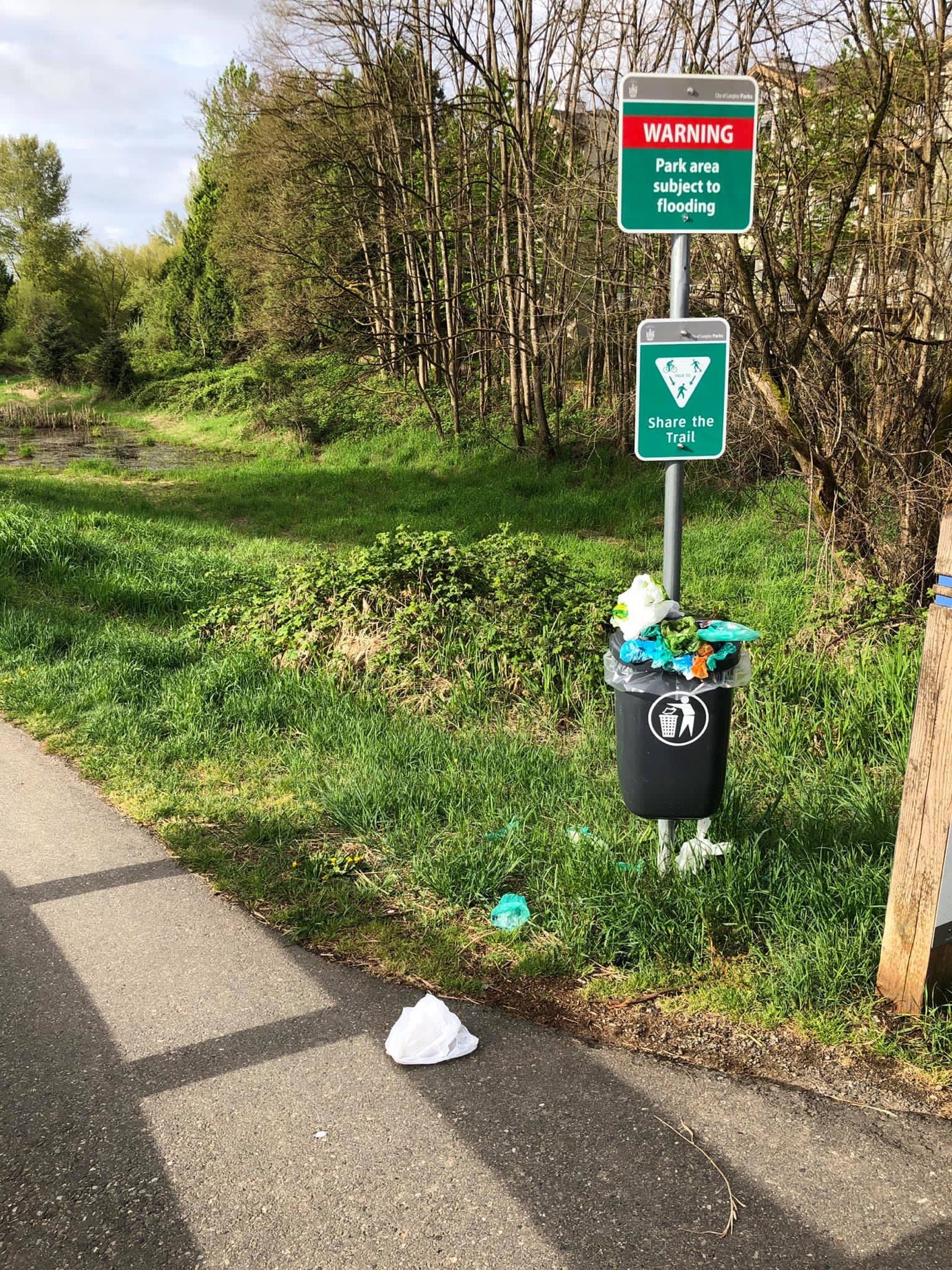
Overflowing garbage can

At the latest Zero Waste Committee meeting, Metro Vancouver Regional District staff provided an overview of single-use item restriction regulations from federal, provincial, and local governments.

The problem with many single-use items, especially those used out of home, is that they turn into litter on our streets, parks, and natural areas. Worse, they get into our oceans and waterways, breaking down into microplastics that enter our food system. Litter has an economic cost, including cleanup costs borne by local governments.

The federal government recently banned the manufacturing and importing of the following plastic items starting on December 20, 2022: checkout bags, cutlery, stir sticks, straight straws, flexible straws packaged with beverage containers, and ring carriers. The federal government also banned foam takeout containers. Businesses can use up existing stocks until December 20, 2023, when the federal government will ban the distribution of these single-use items.

The provincial government previously allowed local governments to regulate the sales and uses of checkout bags, drinking straws, foam takeout containers, utensils, and stir sticks. Federal regulation effectively eliminates the need for local government to regulate those single-use items.

The provincial government released an “intentions paper” on single-use items, which includes a proposed list of items they are considering banning.

In addition to what the federal government has already banned, the provincial government is proposing to ban starting in 2024:

  • All containers, bowls, plates, trays, cartons, film wrap, and cups made from polystyrene foam, PVC or compostable plastic.
  • All packaging made from oxo-degradable plastic, including oxo-degradable bin liners, dog waste bags and clothing packaging.

Monday, March 27, 2023

March TransLink Mayors’ Council: Provincial and Federal Policies Put Pressure on Transit System

On Friday, I attend the Mayors’ Council on Regional Transportation meeting. The Mayors’ Council is one of the two governing bodies of TransLink. TransLink’s CEO Kevin Quinn provided his monthly update on the transportation agency. He noted that ridership continues to rebound and is at 84% of 2019 levels. He also announced “Transit for the Planet” for Earth Day on April 22nd, where there will be giveaways at major SkyTrain stations.

TransLink staff presented at the meeting that the transit system faces uneven pressure due to provincial and federal government policies that are helping to transition to a clean future and ensure we have a growing job market.

These pressures include higher than expected immigration levels to Metro Vancouver, with people settling in the South of Fraser and areas well served by transit. The South of Fraser also has lower levels of work-from-home than over parts of the region. Transit ridership is well above 2019 levels in the South of Fraser, and some routes are now overcrowded.

2021 census tracts where recent immigrants comprise a high proportion of the population. Green is around 5%, Light Blue is between 5-10%, and Dark blue is above 10% of the population. Select the map to enlarge.

The rapid uptake of electric vehicles as part of the CleanBC Plan is reducing the revenue TransLink needs to provide transportation services, as gas tax revenue is declining as people adopt EVs.

The provincial government announced $479 million in stopgap funding to keep our transportation system running as we work towards new stable funding for TransLink, which will take the provincial government’s support to replace the gas tax.

The federal government’s immigration policies support our economy, but also strain local and regional infrastructure. The federal government should speed up the implementation of their permanent transit fund to help build transit to support our growing population.

Later in the meeting, the Mayors’ Council approved sending an official submission to the provincial government on their BC Clean Transportation Action Plan. The mayors asked the province to:

  • Incorporate the already approved regional goals, targets, strategies and actions from Transport 2050, Climate 2050, and Metro 2050 into the BC Clean Transportation Action Plan.
  • Collaborate with TransLink and Metro Vancouver to implement these approved regional plans, focusing on funding and implementing Transport 2050: 10-Year Priorities.
  • Work with TransLink and Metro Vancouver on the Driving Down Emissions project to identify and evaluate viable regulatory and policy tools to reduce GHG emissions from the transportation sector.

Thursday, March 23, 2023

Langley City Council Set City’s Priorities for the Coming Year

There are two ways that municipal councils can set the direction of cities. One way is through motions proposed by induvial council members, and the other is through adopting strategic plans developed by all council members. In either case, the majority of council must be in favour for them to be in effect. The challenge with using motions is that they are ad-hoc and make it challenging for city staff to know the priority of a motion’s objectives compared to all the other objectives a city has. Most motions also require financial resources and staff time, which can undermine other objectives. For these reasons, strategic plans are the preferred way to move forward on the objectives of a council.

Langley City Council will be working on a five-year rolling strategic plan, but Council wanted to get to work quickly, so we adopted an interim plan for this year. The following are the objectives that Council asked Langley City staff to work on over the next year.

  • Evaluate our financial planning process to ensure that it is not only robust, timely, consultative, and transparent but also takes into account current and long-term strategic priorities as well as capital and operating budget requirements identified under the Official Community Plan, asset management plans, and various long term infrastructure plans;
  • Assess potential risks to the City services and partnerships due to political, economic, social, and environmental changes and uncertainty, thereby being able to develop mitigation plans to offset the risks;
  • Review and update the current Tenant Relocation Policy to provide a suite of reasonable and appropriate housing relocation options that will protect the interest of tenants who will be relocated due to redevelopment;
  • Support the Healthy and Resilient Community Dialogue Series that engages community leaders, provincial agencies, social service groups, community partners, residents and business owners, industry experts, and practitioners to examine homelessness, health, social issues, community safety, and well-being issues affecting our community. Through these conversations, we hope to identify best practices and develop a community action plan that addresses the issues and assists us with community planning decisions; and,
  • Ensure we remain focused on completing previous strategic initiatives such as moving forward with Truth and Reconciliation with Indigenous Nations, updating our Zoning Bylaw to prepare for SkyTrain, creating a Sustainability Charter & Urban Forest Management Plan to tackle climate change and its impacts, and renewing the Fraser Highway One-Way to replace century-old infrastructure.

Wednesday, March 22, 2023

TransLink invests $3.1 million into road, walking, and cycling improvements in Langley City

Glover Road Bike Lanes

Besides transit service, TransLink provides funding to improve and maintain the regional road network and funds active transportation infrastructure to make walking, rolling, and cycling safer and more comfortable.

TransLink has funded significant active transportation projects, including the 203rd Street, Glover Road, and 208th Street bike lanes. TransLink has also funded the Duncan Way multi-use path, Langley Bypass Logan Creek culvert replacement, and bus lanes along Fraser Highway, 203rd Street, and Logan Avenue.

TransLink is funding paving the BC Hydro trail between 53rd Avenue and 200th Street and the Downtown bike lane project, which will start construction soon.

This year, TransLink is investing an additional $3.1 million toward the following projects:

  • Building safer and protected bike lanes on the south side of Michaud Cresent - $1 million
  • Enhancing walking/rolling safety at the Douglas Crescent/203rd Street/56th Avenue intersection - $0.2 million
  • Upgrading the Langley Bypass roadway and active transportation infrastructure (from Fraser Highway to 56th Avenue)* - $1.1 million
  • Renewing the culvert under 200th Street at Brydon Creek - $0.8 million

*The City will be applying for additional funding from TransLink in 2024 and 2025 for this project